Friday, 31 December 2010

2011 - the year for a revolution in co-operation?


Over the last two years, Plaid Cymru has issued a number of papers and carried out a series of events aimed at consulting people in Wales in preparation for our manifesto for next year's Assembly elections. Hundreds of people have participated in one-day conferences focussing on climate change, security, communities, town centres and more. I participated in many of these events where there were often lively, informative and stimulating discussions.

Some common themes have emerged. Energy and food security must be planned for. Jobs are essential, particularly in those areas which have suffered from economic decline since the devastation of Wales's heavy industry. Difficult economic conditions coupled with public sector cuts means that long term planning is needed if the parts of the Welsh economy are to avoid becoming depressed.

Over the coming weeks, I will be publishing a 'greenprint for the valleys', a specific set of proposals which aims to pull together the themes from the consultation days into a long-term plan to create jobs which prepare us for the future. By aiming for self-sufficiency, can we create our own markets and capacity to start a revolution in renewable energy, home energy efficiency, public transport and food production? Can we utilise existing government initiatives like feed-in tariffs and youth training schemes as well as public sector procurement and encourage the formation of co-operatives to create jobs to do work that will benefit our communities in the long term?

With responsibility for the plan laying with someone with a seat at the Welsh government table, the plan should be implemented in a pilot area covering the most economically deprived communities within the EU Assisted area known as West Wales and the Valleys. In the run-up to the Assembly elections I will be taking the proposal to the different valley communities to hear to peoples' views. In the longer term, I hope that successful aspects of the plan could be rolled out throughout Wales.

Can people be motivated to get involved in a plan to turn-around local economies and communities? Are people up for thinking about an alterative to Cameron's 'Big Society' here in Wales?

If you would like an advance copy of the consultation 'greenprint', or you would like to be kept informed about the meetings planned for the valleys, or you would like more information about Plaid Cymru, please send an e mail to leanne.wood1@virgin.net.

Monday, 27 December 2010

What's this referendum all about?


On 3rd March, people in Wales will go to the polls to decide the future of Wales's law-making system. This explanation is taken from an interview for Celyn magazine issue#3 - Autumn 2009


What’s wrong with the current legislative system, given that it has been in place for a relatively short amount of time?

There are two stages to our legislative system in the Assembly. The first stage involves getting the competence to make the laws drawn down from Westminster and the second stage is making the law itself. The first stage is the issue that has caused the problems. It has been slow and due to a limit on UK Parliamentary time there has been a limit on the number of competence orders we can ask for. There have been opportunities for those who are not positively disposed to devolution to interfere in the system and to water down the demands of the Assembly. If we get a ‘yes’ vote in the referendum we will be able to move straight to the second stage of the process. We won’t have to ask for competence from Westminster and will be able to get on and make those laws in the areas where competence is devolved to the Assembly.


What difference would it make to Wales if the Assembly took powers directly in the 20 areas it currently has responsibility for rather than having to go to Westminster initially?

The main difference is that we could make measures and legislation much more quickly than we can at the moment. We would have more capacity for making measures in the Assembly and there would be fewer opportunities to those who are not disposed to devolution to interfere in the process. Although holding a referendum implies there would be a big change, it is, in reality, little more than an administrative tidying up exercise.

The Assembly has had problems trying to acquire the power to suspend the right-to-buy in areas of high housing pressure. The Right to Buy, brought in by Thatcher, is responsible for taking more than 135,000 council houses out of the public sector in Wales. In order to stop the leaching of houses from the public sector we need to stop the sale of those houses. The Assembly wanted to make that law but the MPs in Westminster have prevented that happening so far. The Deputy Minister for Housing, Jocelyn Davies had to make a fresh attempt to draw down the powers after her first application was blocked. Hopefully, we will be able to suspend the right-to-buy at the end of this Assembly term but only when I see the legislative competence order before the Assembly will I believe it. [update: the LCO has now been granted and the affordable housing measure is going through the Assembly – after three and a half years.]


Would making those decisions in Cardiff really make any difference to the lives of the people of Wales and, if so, how?

People can now have a much greater input into the laws that affect their lives. Many organisations, if you ask them, would support a yes vote in a referendum for that reason. People will not be getting up the morning after a yes vote people declaring ‘my life is a whole lot better’ because the Assembly has the power to make laws.

It will be difficult to see any immediate change but in the long term, I think we will gain more confidence in our ability to do things for ourselves and people in Wales will take a much more active role in contributing to the legislation that affects their lives.

A yes vote will not be earth-shattering, but a no vote would indicate a lack of confidence in devolution as a project and in Wales as a nation. From what I see, most people are proud of what Wales has become. They will have a chance to register that pride on March 3rd.

Sunday, 26 December 2010

How to stop the tax cheats


The Tax Justice Network and Tax Research UK have produced a eight point manifesto to stop tax dodgers. Tax expert Richard Murphy says

"Britain has a particular problem with tax cheating. London lies at the centre of a global tax haven empire and tax cheating has become the norm at boardroom level and among rich people. It is not helpful that so many politicians are themselves users of tax havens."

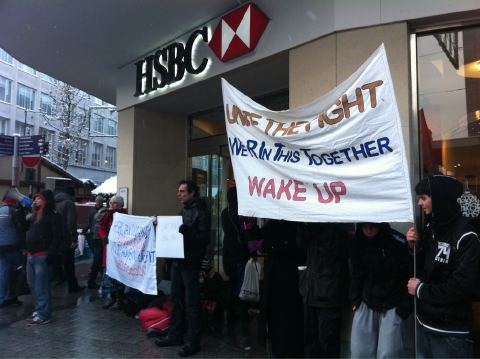
The ConDem government in London want to cut the deficit, but are unlikely to do anything about tax dodgers as many of them are engaged in the practice themselves. 2010 saw the birth of UKUncut. With protests organised and information shared on twitter, UKUncut are exposing tax dodgers, showing how we are not all in this together. Does tax-dodging enrage you? Why not make a pledge to yourself to do something about it in 2011?

Friday, 17 December 2010

Don't Do As I Do, Do As I Say.


Rarely do I read the People newspaper but I did for a review of the Sunday papers on Vaughan Roderick’s politics show on BBC Radio Wales recently. The paper caught my eye because of its coverage of a growing movement which has received scant attention from much of the mainstream media.

In response to the huge amounts of tax evasion and avoidance the UK's super-rich are getting away with, people have begun to join together under the banner of UK Uncut, targeting the businesses associated with tax-dodging. The flagship Top Shop store on Oxford Street, London, was closed down a few weeks ago by people chanting and blowing whistles in protest. Demonstrations were simultaneously held in Top Shop and other Arcadia Group stores in 20 other towns and cities. The boss of Top Shop and the Arcadia empire, Sir Philip Green, has irked the protestors by avoiding paying tax on more than £1 billion. He achieved this by giving his wife Tina, a resident of Monaco, a tax-free £1.2 billion dividend in 2005. The clever accounting that permitted this may have been legal, but it was far from ethical in my mind, or clearly in the minds of the protestors who flooded into the Oxford Street store in their droves.

Vodafone has also found itself on the receiving end of UK Uncut’s campaigning after it was alleged they were let off a £6bn tax bill by Her Majesty's Revenue and Customs (HMRC) – allegations both organisations deny. Nevertheless, the finger of suspicion remain as similar protests to the one visited upon Top Shop stores have taken place at Vodafone outlets throughout the UK this year.

Tax evasion is a practice that has been going on for decades but it seems to be increasing with every year. Now it seems people are waking up to it at a time when the mantra of David Cameron that ‘we are all in this together’ becomes more hollow by the minute.

The Westminster’s inactivity when it come to tackling tax evasion or avoidance by the super-rich runs parallel to their crack-down on the welfare state, which provides a safety net against destitution for those who are unable to work. Rarely has there ever been a purer distillation of the maxim there is one rule for the rich and another for the poor.

In a paper produced by the PCS union,tax evasion is cited as being not less than £70 billion and possibly as high as £120 billion, per annum in the UK. Guardian columnist Polly Toynbee claims £70 billion a year is being criminally evaded in tax, £25 billion avoided and £25 billion simply not paid at a time when tax inspectors are being made redundant in their droves at HMRC.

To put this astronomical sum into context, it has been estimated that benefit fraud costs the state £1.6 billion. You’d think the Government would set their sights on targeting the larger of the two sums if they were genuine about tackling the UK’s debt before giving way to other considerations. Are we really expected to believe Con/Dems are not driven by political ideology? Is it really a coincidence that the Tory party has always strived to protect the interests of the wealthy few? Their efforts to close off higher education to all but the wealthiest, helps to understand why people are beginning to get very, very angry.

When it comes to the millionaire-stuffed Con/Dem cabinet’s preaching about the need to balance the books and be in this together, they should really take a closer look at their own affairs. Chancellor George Osborne, along with other family beneficiaries, will neatly side-step an estimated £1.6 million in inheritance tax thanks to the trust fund, now believed to be worth more than £4 million, that his father set-up. He is not the only UK Government Cabinet figure the finger of blame has been pointed at. Transport Secretary Philip Hammond and International Development Secretary Andrew Mitchell, whose remit is to alleviate world poverty ironically, have also found to be engaging in some clever accounting to the detriment of UK tax revenues. As for Lord Ashcroft, the less said the better.

As history has shown with the Tories, it is a case of ‘don’t do as I do, do as I say.’ I hope more and more people join the peaceful protests being organised by UK Uncut because the Con/Dem Government and the large corporations they protect need to be embarrassed into doing the right thing.

Weather permitting, a demonstration is taking place at 10am tomorrow (Saturday) outside Top Shop in Queen Street, Cardiff. Protestors are urged to bring their own banners if possible. I hope to be there. There are rumoured to be similar events taking place in Swansea, Aberystwyth and Wrexham this Saturday for what is traditionally the biggest shopping day of the year for large corporations like Top Shop. Let’s hit them where it hurts – in the pocket.

Monday, 6 December 2010

Eating Humble Pie


The powers-that-be on RCT council have finally had a dose of reality and ditched their controversial plans to overhaul post-16 education. Although the plans have been put on the back-burner rather than shelved outright, this may be more about trying to save face. It would be astounding if this deeply unpopular, expensive scheme ever saw the light of day again.

The council’s post-16 education proposals would have spelt the end of sixth forms and the creation of three new bilingual colleges taking their place. The plans provoked widespread concern among staff and their trade union representatives, as well as parents and students, because of the implications the move would have had on Welsh medium education, faith schools and special needs provision. Costing millions, the council said they would have borrowed through the Private Finance Initiative if the finance was not forthcoming from the Assembly. I would support moves to improve the education provided to teenagers and an expansion in the range of subjects available, but this proposal was not the best way to achieve those aims.

This embarrassment for RCT chiefs came shortly after news that thousands of loyal, hardworking staff were threatened with a ‘lock-out’ unless they were prepared to accept worse terms and conditions. Just like the Con/Dems in Westminster, the council justified their bully-boy tactics because of the pressures on their budget but this reprehensible behaviour came before they knew the terms of their financial settlement from the Welsh Assembly Government.

Now the worst case scenario the council were working on has failed to materialise, will RCT chiefs re-think their plans to impose a non-negotiable downgrade to the workers' contracts? The staff running vital frontline services in RCT deserve better treatment and a lot more respect than they have been shown by their Labour-run employer in recent weeks.