Aelod Cynulliad Plaid Cymru dros Ganol De Cymru / Plaid Cymru Assembly Member for South Central Wales
Showing posts with label devolution. Show all posts
Saturday, 15 October 2011
Save Remploy
The network of government-subsidised supported employment factories operating under the Remploy banner are under threat of closure. The consultation on the Sayce Review comes to an end on Monday. The workers and their trades unions have been collecting signatures on a petition as part of their campaign to save the factories. (You can 'like' their facebook page here).
I paid a visit to the Porth factory yesterday. Many of the workers there would love to work in mainstream employment. However, they know the jobs climate isn't good in the valleys and they know plenty of former colleagues who lost their jobs in the Trefforest factory three years ago who are now on benefits. If their Remploy factory closes, they know they are unlikely to get another job.
There is a need for supported employment. There is also a need for services to help people with disabilities get in to and stay in mainstream employment. In some places, there are very few jobs.
With job losses in Wales rising fast, Welsh government action should be taken to protect the 400 plus jobs in the Welsh Remploy factories. I have put the case for the devolution of the Remploy budget, asking the First Minister to make respresentations to Westminster and for a commitment to saving the jobs should the devolution request be granted.
With political will and creativity, for example, by looking at how public procurement contracts could be granted by using article 19 of the EU directive, not only to protect existing Remploy jobs but to expand supported employment opportunities in Wales. I was told yesterday that the Porth factory would be a viable business if they had just one local authority's IT contracts. Remploy has a future in Wales if our government wants it.
Labels:
devolution,
GMB,
public procurement,
Remploy,
Unite,
Wales.
Monday, 27 December 2010
What's this referendum all about?

On 3rd March, people in Wales will go to the polls to decide the future of Wales's law-making system. This explanation is taken from an interview for Celyn magazine issue#3 - Autumn 2009
What’s wrong with the current legislative system, given that it has been in place for a relatively short amount of time?
There are two stages to our legislative system in the Assembly. The first stage involves getting the competence to make the laws drawn down from Westminster and the second stage is making the law itself. The first stage is the issue that has caused the problems. It has been slow and due to a limit on UK Parliamentary time there has been a limit on the number of competence orders we can ask for. There have been opportunities for those who are not positively disposed to devolution to interfere in the system and to water down the demands of the Assembly. If we get a ‘yes’ vote in the referendum we will be able to move straight to the second stage of the process. We won’t have to ask for competence from Westminster and will be able to get on and make those laws in the areas where competence is devolved to the Assembly.
What difference would it make to Wales if the Assembly took powers directly in the 20 areas it currently has responsibility for rather than having to go to Westminster initially?
The main difference is that we could make measures and legislation much more quickly than we can at the moment. We would have more capacity for making measures in the Assembly and there would be fewer opportunities to those who are not disposed to devolution to interfere in the process. Although holding a referendum implies there would be a big change, it is, in reality, little more than an administrative tidying up exercise.
The Assembly has had problems trying to acquire the power to suspend the right-to-buy in areas of high housing pressure. The Right to Buy, brought in by Thatcher, is responsible for taking more than 135,000 council houses out of the public sector in Wales. In order to stop the leaching of houses from the public sector we need to stop the sale of those houses. The Assembly wanted to make that law but the MPs in Westminster have prevented that happening so far. The Deputy Minister for Housing, Jocelyn Davies had to make a fresh attempt to draw down the powers after her first application was blocked. Hopefully, we will be able to suspend the right-to-buy at the end of this Assembly term but only when I see the legislative competence order before the Assembly will I believe it. [update: the LCO has now been granted and the affordable housing measure is going through the Assembly – after three and a half years.]
Would making those decisions in Cardiff really make any difference to the lives of the people of Wales and, if so, how?
People can now have a much greater input into the laws that affect their lives. Many organisations, if you ask them, would support a yes vote in a referendum for that reason. People will not be getting up the morning after a yes vote people declaring ‘my life is a whole lot better’ because the Assembly has the power to make laws.
It will be difficult to see any immediate change but in the long term, I think we will gain more confidence in our ability to do things for ourselves and people in Wales will take a much more active role in contributing to the legislation that affects their lives.
A yes vote will not be earth-shattering, but a no vote would indicate a lack of confidence in devolution as a project and in Wales as a nation. From what I see, most people are proud of what Wales has become. They will have a chance to register that pride on March 3rd.
Labels:
devolution,
Ie dros Gymru,
referendum,
Wales,
Yes for Wales
Tuesday, 7 July 2009
Calls grow for powers over crime to be devolved
On Thursday, the Howard League for Penal Reform joined the numerous bodies that are supporting the devolution of criminal justice to the National Assembly:
"A leading prison reform charity has called for criminal justice policy to be devolved to Wales. And a report by the Howard League for Penal Reform also says there should be greater use of community sentences. The group says public confidence in criminal justice would be boosted by greater control at local level." Their view backs up my criminal justice report's conclusions. If you haven't seen it already, then click here for a copy.
Labels:
criminal justice,
devolution,
Howard League,
penal reform
Wednesday, 6 May 2009
Remembering Thatcher
This is a translation of an article appearing in this week's Golwg.This week marks the Assembly’s tenth birthday. It also marks the thirtieth anniversary of the start of the economic experiment which has since become known as “Thatcherism”. Two decades of being on the losing end of this experiment made it easy to persuade people to vote ‘Yes’ in the referendum which led to setting up the Assembly.
I spent the summer of 1997 campaigning for a ‘Yes’ vote. At that time, people felt largely optimistic about a future which could move on from Thatcherism.
New Labour had just turfed the Tories out of government after 18 years. During that time the Tories had inflicted – without an electoral mandate – gravely damaging policies on Wales. Most people around me in the Rhondda were vigorously opposed to more or less everything the Tories stood for. Valleys people had stood up to the Tories. Throughout the miners’ strike they had given their all in an ideological battle with Thatcher’s government, because they knew that losing would be a disaster. How right they were. The price for losing that battle is still being paid today.
I was eight years old when the Tories came to power in 1979. I belonged to the much talked about “Thatcher generation”, with no memory of anything other than a Tory government. By 1984, I was a first year pupil at Tonypandy Comprehensive School. I remember complaining about having to carry heavy tins into school to give to the miners’ kids, who, because their dads were on strike, were “worse off than us” and so needed our help. But my father wasn’t a miner and so, although the strike had a massive impact on the wider community, it didn’t have an immediate and direct effect on our family life.
That was until my dad was also made redundant. He was out of work for years, which meant reliance on embarrassing home-made or old-fashioned ‘hand-me-down’ clothes, queuing for free school meal tickets, missing out on school trips and events as well as after-school activities like dancing classes. There were a lot of us in that situation. There was a real sense of hopelessness in so many of our home lives.
I have few fond memories of the ’80s – my teenage years. We had a good voluntary, on-a-shoe-string-run youth club offering somewhere to hang out on Mondays through to Thursdays. There were some great teachers in school. But there was no money to “do” things. There were too few free things to “do”. Weekends and school holidays were spent in back lanes or on street corners. Too many of my male contemporaries ended up in the prison system, their crime careers starting with a flagon of Strongbow in the back lanes. Cider too often progressed to other more dangerous substances; drugs like heroin were cheap, easily available and attractive to a generation who’d come to believe that the only thing they had to look forward to was the fortnightly dole giro cheque. Too many girls had babies too early. Jarvis Cocker summed up the culture and the feeling when he sang “We drank, and we danced and we screwed, coz there was nothing else to do.” The best word to describe the atmosphere is “hopeless”.
The defeat of the miners’ strike led to high levels of unemployment. Thatcher’s deliberate decimation of the mining industry and, more importantly, its union caused untold damage, much of which is still starkly visible today. In some valleys areas, a fifth of young people are out of work. Mental health, problematic substance usage and crime levels are shockingly high in some former mining areas, as are statistics for poverty, ill health and premature death. The legacy and the memory of Thatcher’s policies will not fade easily in my part of Wales.
But it would be too easy to place all responsibility for this onto one person. Margaret Thatcher is a powerful icon, but she is merely the symbolic UK representative of a global neo-liberal/free market economic movement which was embraced and continued by Labour after the Tories left office. In 1979 Thatcherism broke with the post-war consensus which favoured and supported the welfare state. Breaking that consensus and aiming to cut the size of the state was a revolution – but not a good one.
The current economic crisis has now laid bare the problems at the heart of the Thatcherite free-market experiment. This situation necessitates a new break with the neo-liberal consensus that has dominated UK politics since Thatcher came to power in 1979. Wales has never shown much of an appetite for Thatcherite economics and it can be argued that the Assembly would not now be celebrating its tenth birthday had we not lived through Thatcherism. It has to be hoped that her long-term legacy will be a powerful, left-leaning Welsh government, willing and able to defend people in Wales from any more "experiments" imposed by London governments, be they Tory or Labour.
Labels:
#plaidcymru,
1979,
devolution,
neo-liberalism,
Thatcher,
unemployment,
valleys
Tuesday, 3 February 2009
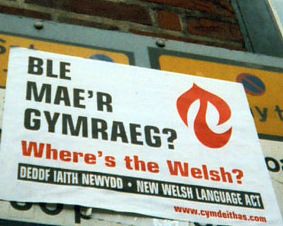
Welsh language legislation- where should it be decided?
The bid for the Welsh language LCO has gone public. It's an historic occasion which I am hoping will is the start of the process of bringing powers over the language home to Wales. The simple point is that legislation to protect the future of the Welsh language should be made in Wales. This is the most democratic and practical way of making laws which will enhance our status as a bilingual nation, and which will establish linguistic rights for Welsh speakers, placing both of our national languages on an equal footing.
If all goes well, the actual detail of the legislation will be debated in our National Assembly once we get the powers transferred. I am looking forward to that moment.
I've just been informed that I'll be on the Assembly legislation committee responsible for scrutinising the LCO, so watch this space!
Wednesday, 5 November 2008
Tories show their true colours
The Tories' long-awaited report on devolution has been published today. I'm sure they hope it will be buried- why else would they release it when everyone's attention is on America? In recent years, the Tories in Wales have gone out of their way to cultivate a Wales-friendly image. We've seen a new branding, Wales mentioned alot in their rhetoric, and plenty of sympathetic noises towards the Welsh language. They know that they can't make it in Wales without being a pro-Welsh party.
The report by Wyn Roberts on devolution shows that they're the same old Tories: anti-Welsh and out of touch. Wyn Roberts states that it is "generally believed" a referendum on further powers would not be won. Isn't the whole point of a referendum to measure public opinion?
It's also obvious that Wyn Roberts is out of touch with politics in Wales and also refers to us as a Principality (a term that is thankfully little-used in Welsh politics these days). Couldn't the Welsh Tories find someone who was a little more in touch to write this report?
Despite the fact that during the 2007 coalition negotiations the Tories were prepared to sign up to campaigning for a 'yes' vote in a future referendum, this report fails to commit to such a position. They have not even ruled out abolishing the Assembly altogether. As they come closer to gaining power in Westminster they are reverting to their true colours. Nick Bourne should come out and distance himself from this report. Otherwise, we can only conclude that previously warm words from the Tories on devolution were nothing more than hot air.
Monday, 6 October 2008
Hain in the neck
On Sunday's Politics Show, Peter Hain appeared to oppose the Welsh referendum pledge that his party have signed up to as part of the One Wales agreement (as the Hen Ferchetan reports here). He has said that a referendum should not take place before 2011, because we won't win. He clearly wants to be on the winning side. The whole point of having a referendum is to see whether the people want what is on offer. Waiting for public opinion to change when the pledge has already been made defeats the object. The 'Yes' campaign will take our case to the people of Wales. Do people want a stage-managed referendum?
Welsh Ramblings has questioned whether Hain really is committed to more powers for the Assembly. Times have changed since the Labour party in Wales had its course decided by its MPs rather than its AMs. Welsh Labour's Assembly Group should decide and are deciding their own agenda now. They should have the final say on where Welsh Labour stands on this referendum, not Peter Hain or any other out of touch MP. There is a growing realisation now that Thatcherite policies and economics have been unsustainable and are leading to the possibility an economic collapse. The need to break away from the London consensus has never been clearer, and getting a Parliament, despite its limitations, is the most obvious next step forward. There are difficult times ahead and we should remember Gwyn Alf Williams who wrote how in the past the people were "left naked under an acid rain" of Thatcherism.
Labels:
credit crunch,
devolution,
Gwyn Alf Williams,
Peter Hain,
recession,
referendum,
Thatcher
Monday, 22 September 2008
Gordon Brown gives us the green light
Gordon Brown isn’t a popular figure with Plaid Cymru members. His privatisation agenda, fixation on ‘Britishness’ and support for disastrous wars in Iraq and Afghanistan have not exactly turned the embattled Prime Minister into an electoral asset.
But, Gordon Brown’s speech to the Northern Ireland Assembly shows that miracles can happen. The Bard of Britishness gave his full and strident backing to further and full devolution of powers to Northern Ireland’s Assembly.
The enlightened PM said:
“There is something more vital at stake for your entire society - that only the completion of devolution can deliver.
How can you, as an Assembly, address common criminality, low-level crime and youth disorder
· when you are responsible for only some of the levers for change?
· when you have responsibility for education and health and social development but have to rely on Westminster for policing and justice?"
The people of Northern Ireland look to you to deal with these matters because to them they are important. Full devolution is the way to deliver better services, tailored to the needs of all communities, regardless of the politics. It is the best way for you to serve them.”
Our Assembly needs powers over criminal justice as soon as possible, so that we can get our young people out of the youth crime trap. I have already set out my stall on how this could be done. The Prime Minister's conversion is timely as the charity Barnardo's today delivered one of the most damning verdicts yet on our failing criminal justice system, which incarcerates more kids than any other country in Europe except for Russia and the Ukraine.
Based on Brown’s logic in his Northern Ireland speech, criminality and disorder in Wales is never going to be solved until we have the tools we need to do the job.
Labels:
criminal justice,
devolution,
Gordon Brown,
Northern Ireland
Monday, 7 July 2008
Inconsistent Tories
Alot can be made of the Welsh Conservatives and the transition they have made over the past few years. The party has moved from an anti-devolution position towards apparent support for further powers for the Assembly. Under Nick Bourne's leadership the Tories in Wales took on a new pro-Welsh branding and have also voiced support for the Welsh language. These changes would certainly be welcome if they could stand up to scrutiny, but there is an inconsistency across the Conservative Party at the UK level.
The Tories recently examined devolution and the West Lothian Question in a report published by the Conservative Democracy Task Force. It might have been expected that Wales would have played a key role in the report, because the Tories claim that their attitude shift in Wales shows how the party has come to terms with devolution. But this expectation has not materialised. The report barely mentions Wales and instead deals with the contentious West Lothian Question from an English perspective.
There is clearly a confused and inconsistent outlook on devolution across the Conservative party. The Westminster end of the party still wields the influence and the Welsh Conservatives cannot even commit to a party line that would campaign for a 'yes' vote in our next referendum. An English Parliament could well be a step towards resolving the inequalities of devolution, but the early signs are that the Tories would not afford the same justice to Wales.
The Tories recently examined devolution and the West Lothian Question in a report published by the Conservative Democracy Task Force. It might have been expected that Wales would have played a key role in the report, because the Tories claim that their attitude shift in Wales shows how the party has come to terms with devolution. But this expectation has not materialised. The report barely mentions Wales and instead deals with the contentious West Lothian Question from an English perspective.
There is clearly a confused and inconsistent outlook on devolution across the Conservative party. The Westminster end of the party still wields the influence and the Welsh Conservatives cannot even commit to a party line that would campaign for a 'yes' vote in our next referendum. An English Parliament could well be a step towards resolving the inequalities of devolution, but the early signs are that the Tories would not afford the same justice to Wales.
Monday, 30 June 2008
Don't get worked up over wind
When we signed up to the One Wales programme a year ago, one of the most significant commitments was a plan to reduce carbon emissions by 3% per year. To achieve such an ambitious target we will have to use whatever renewable energy sources are available to us. At the moment, wind power is the most advanced and readily-available form of renewable energy. As long as the main responsibilities for energy lie with Westminster, we will have to make use of whatever we can. To do nothing and wait for London to form our energy policies for us would be a dereliction of duty. Although Westminster does have this control, we do still have the power to determine projects with a generating capacity of up to 50MW.
I support the One Wales Government's decision to revise upwards the levels of planned wind farms in the Strategic Search Areas. While no-one wants to see the whole of Wales carpeted in wind farms, we have to make use of the abundant wind that we have. Most people seem to favour offshore wind power as an alternative to onshore sites. Offshore sites can provide far more energy than onshore wind can, and have less of an impact on the landscape. But because many offshore wind developments are greater than 50MW, Wales is not allowed to have a say. Some of the largest offshore wind developments in the world are currently being planned around Wales. This is to be welcomed because these projects will reduce the need for so many wind farms in our countryside, but the Government of Wales and the Assembly won't have the final decision on such developments.
The latest proposals for more wind power will result in less than 1% of the Welsh landscape accomodating wind projects. I can still sympathise with wind energy's critics when they state that even this small amount of affected land is a great loss to the Welsh countryside, but if we are to play our full part in fighting climate change we must make these sacrifices. In the long-term, Plaid Cymru would not advocate an over-reliance on wind, just because it is the most convenient source of renewable energy. We need to ensure that the One Wales Government does not neglect micro-generation and other decentralised energy options and that we continue to demand that Westminster gives us the powers to determine our own energy future.
I support the One Wales Government's decision to revise upwards the levels of planned wind farms in the Strategic Search Areas. While no-one wants to see the whole of Wales carpeted in wind farms, we have to make use of the abundant wind that we have. Most people seem to favour offshore wind power as an alternative to onshore sites. Offshore sites can provide far more energy than onshore wind can, and have less of an impact on the landscape. But because many offshore wind developments are greater than 50MW, Wales is not allowed to have a say. Some of the largest offshore wind developments in the world are currently being planned around Wales. This is to be welcomed because these projects will reduce the need for so many wind farms in our countryside, but the Government of Wales and the Assembly won't have the final decision on such developments.
The latest proposals for more wind power will result in less than 1% of the Welsh landscape accomodating wind projects. I can still sympathise with wind energy's critics when they state that even this small amount of affected land is a great loss to the Welsh countryside, but if we are to play our full part in fighting climate change we must make these sacrifices. In the long-term, Plaid Cymru would not advocate an over-reliance on wind, just because it is the most convenient source of renewable energy. We need to ensure that the One Wales Government does not neglect micro-generation and other decentralised energy options and that we continue to demand that Westminster gives us the powers to determine our own energy future.
Monday, 19 May 2008
Towards a Welsh system of justice
Yesterday's Politics Show covered a paper I have written entitled 'Making Our Communities Safer'.
My argument is that the criminal justice system is not working and so should be devolved to Wales. Overcrowding in prisons has reached an all-time high and imprisonment rates in England and Wales are higher than other comparative Western European countries. By devolving criminal justice to Wales we could take a completely different approach, tacking the causes-not just the symptoms- of crime.
The Howard League for Penal Reform have said that "we were recently in Scotland, where criminal justice is devolved, and we were greatly impressed with the enthusiasm of the Scottish justice minister, Kenny MacAskill. We do believe that devolving criminal justice will usher in more innovative thinking and allow Wales to get off the runaway train to disaster which is Westminster's current prisons policy."
The One Wales programme has a commitment to examining the evidence for the devolution of the criminal justice system, and my paper represents Plaid Cymru's contribution to that evidence. Above all, I hope that this sparks debate around the issue because it is an area where we could really make progress for Wales.
You can read the discussion paper here. Send an email to leanne.wood@wales.gov.uk, including your postal address if you would like a hard copy.
Readers may also be interested in Andy Newman's analysis of my report over at Socialist Unity.
My argument is that the criminal justice system is not working and so should be devolved to Wales. Overcrowding in prisons has reached an all-time high and imprisonment rates in England and Wales are higher than other comparative Western European countries. By devolving criminal justice to Wales we could take a completely different approach, tacking the causes-not just the symptoms- of crime.
The Howard League for Penal Reform have said that "we were recently in Scotland, where criminal justice is devolved, and we were greatly impressed with the enthusiasm of the Scottish justice minister, Kenny MacAskill. We do believe that devolving criminal justice will usher in more innovative thinking and allow Wales to get off the runaway train to disaster which is Westminster's current prisons policy."
The One Wales programme has a commitment to examining the evidence for the devolution of the criminal justice system, and my paper represents Plaid Cymru's contribution to that evidence. Above all, I hope that this sparks debate around the issue because it is an area where we could really make progress for Wales.
You can read the discussion paper here. Send an email to leanne.wood@wales.gov.uk, including your postal address if you would like a hard copy.
Readers may also be interested in Andy Newman's analysis of my report over at Socialist Unity.
Labels:
criminal justice,
devolution,
Howard League,
One Wales
Thursday, 17 April 2008
Tories oppose devolution of housing powers
My letter to Tory leader David Cameron appealing for Tory support for the development of devolution seems to have caused a bit of a stir. Two high profile Tories have responded to my letter. However, both have missed the point.
This is not an argument about affordable housing or the right to buy. Its about devolution. The time to argue about whether or not to suspend the right to buy should take place if and when the assembly government wants to change the law. At the moment, we are asking Westminster for the powers or the ability to change the law. Glyn Davies claims to support law making powers over devolved areas. Housing is devolved. Law making powers over housing should be devolved.
The Tories in Wales have made great efforts to shed their anti-Welsh devolution image. By opposing this LCO, they have failed their first practical test. Their words have been shown up as completely hollow, they clearly don't care about Welsh devolution.
This is not an argument about affordable housing or the right to buy. Its about devolution. The time to argue about whether or not to suspend the right to buy should take place if and when the assembly government wants to change the law. At the moment, we are asking Westminster for the powers or the ability to change the law. Glyn Davies claims to support law making powers over devolved areas. Housing is devolved. Law making powers over housing should be devolved.
The Tories in Wales have made great efforts to shed their anti-Welsh devolution image. By opposing this LCO, they have failed their first practical test. Their words have been shown up as completely hollow, they clearly don't care about Welsh devolution.
Labels:
affordable,
David Cameron,
devolution,
Dylan Jones Evans,
Glyn Davies,
housing,
oppose,
Tories
Subscribe to:
Posts (Atom)