Wednesday, 29 April 2009

From the Record


Leanne Wood: You will be aware of the widespread concern about the actions and tactics of the police during recent demonstrations in London around the G20 summit. There remain many unanswered questions about the death of Ian Tomlinson and other aspects of the policing operation, which are being looked at by the Independent Police Complaints Commission.
However, I am sure that you will agree that we would all want to ensure that a similar situation does not arise in Wales, and although I accept that policing is not a devolved matter, peaceful protests and demonstrations are, thankfully, common in Wales. Since the Assembly has been created, thousands of people have taken part in political demonstrations outside this very building. By pursuing tactics such as kettling, there is a risk that the police will lose the trust of a significant number of our population. Do you share my concerns about the heavy-handed police action at the recent protests in London and will you make time available in the Assembly so that Members can have the opportunity to express our support for the right to protest peacefully?
Will you ask the Minister for Social Justice and Local Government to provide a statement to the Assembly, so that Members can be updated on the latest situation with regard to the 'One Wales’ commitment to the devolution of the police in particular and also the wider criminal justice services?
If policing matters were devolved to the Assembly, as Members, we would be able to have an input and a say as to how demonstrations in Wales in the future were policed.
Carwyn Jones: I will ask the Minister to update Members on the latest situation regarding the commitment, but we must understand that that is an event that occurred in London, and, even if policing was devolved in Wales, that would not affect what happened in London. I do not think that I can comment on the situation that happened during the protest, nor do I think that it would be wise for anyone in Government to do so, because an investigation is taking place at the moment, which must be allowed to run its course.

Monday, 27 April 2009

Youngsters left voiceless in Llantwit Fardre by council youth club takeover

Most people would agree that young people need facilities to keep them occupied and to give them a place to go outside of school hours. Until recently the Llantwit Fardre Young Peoples Project (LLYPS) operated two nights a week out of the Garth Olwg Youth Centre. RCT Council's in house youth provision ran on two other nights of the week.

I met with the project shortly before its agreement with RCT Council was annulled by the Labour-run Local Authority. In the same week the Council Leader was speaking in his capacity as a member of the Police Authority, saying money was being made available for youth projects! As Council Leader, Cllr Roberts was ending the provision of a succesful youth service at Llantwit Fardre.

LLYPS has been praised by local police officers because they had contributed to the reduction of so-called "anti-social behaviour" and crime in the area through their street-based youth work. A success story! LLYPS also offered people the opportunity to improve, for example through the Duke of Edinburgh award.

LLYPS was a specialised service run by volunteers as a charity. Young people could dress as they wanted to, play music and generally be themselves. This contrasted with the council-run nights which were described as being much more strict- and not as well attended. Young people described some staff members at the Council-run nights as “walking around like security guards”.

RCT Council have now taken over all nights at the Garth Olwg Youth Centre, cancelling the LLYPS provision with no consultation and an inadequate explanation. The voices of the young people were not heard. I wrote to the Children's Commissioner for Wales, who said that he was unable to intervene in a specific Local Authority decision. There is a danger now that the poorly attended Council-run nights at the Youth Centre will not meet the needs of the youth in the area.
For now, Rachel Brydon who used to run LLYPS is continuing her work as a street-based youth worker. But LLYPS needs the use of a building. RCT has let down the young people in the Llantwit Fardre and Church Village areas, and they shouldn't be allowed to get away with it.

Thursday, 23 April 2009

Budget disaster for Wales


£416 million will be cut from the Assembly's budget next year. New Labour are calling the cuts "efficiency savings". Adam Price said yesterday:

"When taking these and other already announced cuts into account, public services in Wales will be around one billion pounds per year worse off by 2013-14."

This is disasterous news for Welsh public services. Swathing cuts to frontline services are inevitable. Its difficult to see how these cuts can be implemented without job cuts. Jobs are already at risk at the Mint.

The public sector should be providing jobs now, not cutting them. Great opportunities have been missed to invest in a Green New Deal - something that could have provided thousands of jobs and training opportunities well as helping us to prepare the way for the effects of climate change and peak oil.

Why didn't the chancellor scrap the plans to introduce ID cards and replace the TRIDENT nuclear missile system? Billions could have been saved in two simple moves. Instead, the poorest - those who make most use of public services and who don't have the luxury of being able to afford alternatives will bear the brunt of these cuts.


Tuesday, 21 April 2009

Breaking News: Royal Mint to be Privatised

I have learnt ahead of the official announcement that the UK Government will be privatising the Royal Mint at Llantrisant.

The Mint made a profit of £10m last year and according to Rhodri Morgan is due to take on additional staff as a result of winning the contract to produce medals for the Olympics. The PCS Union is deeply concerned about the effect this will have on jobs.

Plaid Cymru has consistently opposed the privatisation of the Mint. The Welsh Government is against it, the workers are against it and the local communities are against it.

The Mint was brought to Llantrisant in 1967 as part of a "regional economic strategy" to redistribute jobs throughout the UK.

Labour MP Huw Irranca-Davies recently said:

"Look at some of the benefits we've had over the years in terms of public sector jobs...in Llantrisant we've had the Royal Mint, relocated by Jim Callaghan."

"If Plaid Cymru, Adam Price or anbody else want to enter the debate about what independence would mean for Wales, they have to explain how those jobs would be defended."

How can the UK Government argue that they are defending Welsh jobs now?

Sunday, 19 April 2009

Treherbert pool under occupation

Today I've been supporting campaigners in their last ditch attempt to save Treherbert pool. The council decided to close the pool without consultation in order to save money. Campaigners have formed a committee and are prepared to manage it themselves. With help from the Wales Co-operative Centre, they have prepared a business plan which the council has agreed to look at. But they needed a stay of execution. That request was refused.

The pool will now be "mothballed", with the council saying it can be re-opened if the budget situation improves. No-one expects to see budget increases in the short term.

Today was the pool's last day. A small group of us refused to leave at closing time, and one person is still in there.

Treherbert is a Communities First ward, which means it gets additional money to reduce deprivation levels. Treherbert has recently lost two post offices, allotments, the disabled riding school and the park ranger. Communitites First wards are meant to have extra facilities - they shouldn't be losing amenities. The kids will have too far to travel to exercise their right to free swimming, meaning the health statistics for the area can only get worse.

People in Treherbert are left wondering what they will lose next. There are already rumours about the youth centre and people are fearful for the future of the local library.

The upper Rhondda Fawr is within the Heads of the Valleys Regeneration area. How can losing the pool help with regeneration?

Friday, 17 April 2009

Celyn - green, red and spiky!

Celyn is a new bi-monthly publication that promises to be green, red ... and spiky! The first edition is due to come out during the first week in May to coincide with the 10th anniversary of the first Assembly elections.

Celyn aims to provide a non-sectarian vehicle for Welsh and international politics, ideas and debate - we hope to move beyond party tribalism.

Our editorial board consists of political activists from Plaid, Labour, the Communist Party, Trades Unions and the green/anti-war movements. If you'd like to subscribe, send a cheque made payable to Celyn (£15 waged, £8 low/un-waged) to 21 Hafod Street, Grangetown, Cardiff, CF11 6RB or let us know if you would like to take out a standing order.
You can also join the Facebook group here.

We'd love to know what you think of our first issue. If you have any views on that, or any contribution you would like to make to a future issue, please let us know.

Wednesday, 15 April 2009

Severn Estuary Public Meeting

Last week Plaid organised a public meeting in Penarth to discuss the potential impact of a Cardiff to Weston or Severn Barrage. More than 150 people attended to hear Gordon James from Friends of the Earth, Peter Jones from the RSPB, and Plaid MEP Jill Evans spoke. In general, people opposed the Barrage because of the effect it would have on the envionment, the disruption it would cause to their communities and that it would take more than twenty years to construct. Most people supported harnessing energy in the estuary., but preferred the less damaging alternatives.

It was clear from the meeting that the UK Government has not disseminated enough information about its plans for the Severn Estuary. People at the meeting had not been contacted by any government agency and so it could be said that the local community's feelings are not being taken considered as part of the decision-making process. That's why we organised the meeting and why we have distributed information about the consultation. Hopefully the voice of communities in and around will now be heard.

Thursday, 9 April 2009

IPCC Investigation

The Independent Police Complaints Commission has agreed to manage and direct the investigation into the complaint about the gunpoint arrest and incareration of Victor Frederick.

The family received an apology and a partial explanation following their participation in a press conference. But none of us have been satisfied that other innocent people will not face a similar ordeal in the future. I sincerely hope that that the IPCC investigation is thorough and that it provides the answers and assurances we need to ensure that what happened to Victor and his family is not repeated again.

Wednesday, 1 April 2009

Solidarity with Latin America


I have invited Assembly Members and staff to a meeting tonight to discuss the setting up an All-Party Group on Latin America with a launch reception to mark the 50th anniversary of the Cuban revolution, and the 10th anniversary of the election of Hugo Chavez as President of Venezuela.

Peter Black has criticised the event on his blog. His post 'Supporting the Dictators' can be read here. Hugo Chavez is not a dictator and there is more to Cuba than just Fidel or Raul Castro. The event and group are about building solidarity with two socialist administrations that would collapse if they did not have massive popular support.

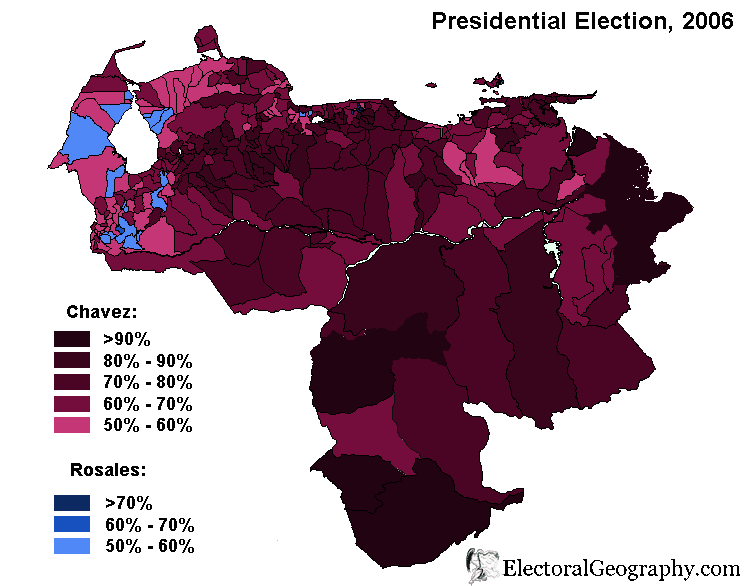
Hugo Chavez has been repeatedly elected in Venezuela through internationally monitored free and fair elections, with huge majorities. When he did lose a referendum he accepted the result. The assertion that Chavez has sought election as 'President for life' is also untrue. He supported a referendum on removing term limits, which has given Venezuelan officials (including anti-Chavez politicians) the same right to run for office that politicians in the UK have.

Cuba of course is not a liberal democracy like the UK, United States or other Western countries are. If Peter had been to Cuba he would see that there is a different kind of participatory democracy evident at all levels of society. Of course progress can be made with regards to personal freedoms, but its unclear how such progrss can take place under the current economic blockade and consistent interference by the USA, a country that still wishes Cuba was under its sphere of control.

The context that the socialist administrations in Venezuela and Cuba are developing in is entirely different from here in Wales. Programmes which have taught all people to read and write and measures to ensure all have access to good quality healthcare and education that is worth supporting and that is why I am backing a group at the Assembly to build links and solidarity with these struggles.